



You will not be allowed to compare more than 4 products at a time
View compareNABH Accredited Ayurvedic Hospital
Ayurvedic Lumbar Spondylosis Treatment in Hyderabad: Precise Diagnosis, Customised Care
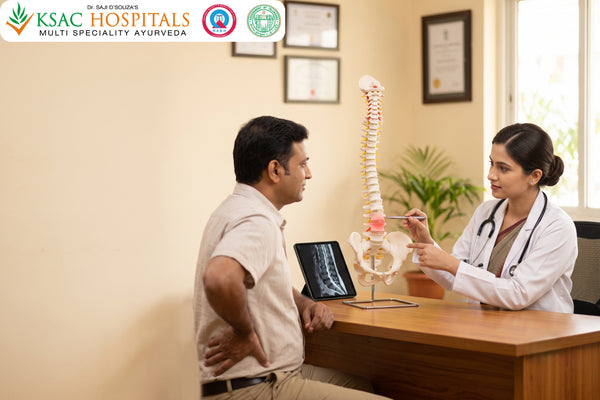
KSAC Hospitals provides structured ayurvedic lumbar spondylosis treatment in Hyderabad for patients living with chronic lower back stiffness, reduced spinal mobility and pain from degenerative change in the lower spine. Every plan begins with a precise diagnosis. The treating doctor reviews the patient's X-rays, MRI or CT reports alongside a clinical and neurological examination to establish which levels are affected, how far the wear has progressed and whether any nerve is involved before treatment is advised.
No two lumbar spondylosis patients are treated the same way. At this Ayurvedic hospital in Hyderabad, specialised doctors prepare a customised plan around the individual's imaging findings, examination, occupation, daily posture and current medication. Mild stiffness at one level and advanced degeneration with nerve involvement are different clinical problems and care is non-surgical, supervised and reviewed by the treating doctor at every stage.
NABH
Accredited (AH-2019-0070)
27+
Years Experience
5000+
Patients Treated
4.9★
319+ Google Reviews

NABH Accredited
Spine Care Centre
What Is Lumbar Spondylosis?
Lumbar spondylosis is a degenerative condition of the lower spine marked by progressive wear of the discs, the small joints at the back of the spine and the vertebrae themselves. It develops gradually as the discs lose water content and height, which reduces the cushioning between the vertebrae. Over time the body may respond by forming small bony spurs along the edges of the vertebrae and those small joints may thicken.
The process can affect several structures at once. Loss of disc height alters how weight is distributed across the spine. Changes in the small spinal joints produce stiffness and localised pain. In more advanced presentations the spinal canal or the openings where the nerves exit may narrow, which can affect the nerve roots leaving the lower spine. Lumbar spondylosis ayurveda understands these changes as part of a wider pattern of tissue depletion rather than as isolated mechanical damage.
It is worth being clear about what this condition is not. Lumbar spondylosis is not the same as lumbar spondylolisthesis, where one vertebra slips forward over another and it is not the same as cervical spondylosis, which is the equivalent degenerative process in the neck. The three differ in mechanism, presentation and management and KSAC Hospitals assesses and treats each separately.
Types of Lumbar Spondylosis
By Severity
Mild Degenerative Changes
Early loss of disc water content with minimal height loss and small bony spurs. Patients may have intermittent lower back stiffness, particularly after sitting for long periods or on waking. The small spinal joints may show early wear without significant functional limitation.
Moderate Spondylosis with Disc Narrowing
Noticeable loss of disc height at one or more levels, with moderate spur formation and thickening of the small spinal joints. Patients typically report persistent lower back pain, longer morning stiffness and reduced flexibility in bending forward and turning. This is the presentation most commonly seen at KSAC Hospitals.
Severe Spondylosis with Canal Narrowing
Advanced disc degeneration, prominent spurs and significant joint change that may narrow the spinal canal or the openings where nerves exit. Patients may have pain radiating into the legs, numbness, tingling or weakness in the lower limbs alongside their back symptoms. Presentations at this end of the range are assessed with particular care, since nerve involvement changes what treatment is appropriate.
By Spinal Level
L3-L4 Involvement
Degenerative change at the third and fourth lumbar vertebrae. Pain and stiffness are usually felt in the mid to lower back.
L4-L5 Involvement
One of the most commonly affected levels, because of the load and movement demands at this segment. Degeneration here may contribute to lower back pain and, where a nerve is compressed, symptoms radiating into the thigh and leg.
L5-S1 Involvement
The junction between the lower spine and the pelvis carries considerable weight load and is frequently affected. Change at this level may produce deep lower back pain and, where nerves are involved, symptoms extending into the foot.
Signs and Symptoms of Lumbar Spondylosis
Consider consulting a lumbar spondylosis specialist if you experience:
- Persistent dull ache in the lower back that may worsen with prolonged standing, sitting or activity, usually felt deeper than ordinary muscular discomfort
- Morning stiffness in the lower back on waking that takes several minutes of movement to ease, becoming more pronounced over time
- Reduced movement in bending forward, leaning back and turning, noticeable in everyday actions such as bending to tie shoelaces or rising from a low chair
- Pain travelling from the lower back into the buttock, thigh or leg where bony spurs, a bulging disc or narrowing affect a nerve root
- Numbness, tingling or a pins and needles sensation in the legs or feet where a nerve is compressed
- Symptoms worsening with lifting, prolonged walking or climbing stairs, with rest and supported sitting giving partial relief
Urgent assessment needed: Progressive weakness in the legs, numbness around the inner thighs, groin or saddle area or any change in bladder or bowel control can indicate serious compression of the nerves at the base of the spine (cauda equina compression). Anyone with these symptoms should seek immediate medical assessment rather than booking elective care.
Common Causes That Contribute to Lumbar Spondylosis
Lumbar spondylosis develops through a combination of age-related wear and contributing lifestyle, occupational and constitutional factors. Commonly recognised causes include:
- Age-related wear: the primary driver is the natural degenerative process in the discs, spinal joints and vertebrae over decades, with disc hydration decreasing progressively from the thirties onward
- Sedentary routine: lack of regular activity weakens the muscles alongside the spine and reduces the support they give it, placing disproportionate stress on the discs and joints
- Prolonged sitting: long periods seated, particularly in postures that flatten the natural inward curve of the lower back, place sustained compressive load on the lumbar discs
- Occupational strain: work involving repetitive bending, heavy lifting, exposure to vibration or sustained awkward posture increases the rate of degenerative change
- Excess body weight: additional weight increases the load on the lower spine and shifts the centre of gravity forward, increasing demand on the lumbar structures
- Prior injury: earlier disc herniation, a vertebral fracture or significant muscle injury may accelerate degenerative change at the affected level
- Genetic predisposition: individual variation in disc structure and spinal alignment influences the rate and severity of degeneration
How Ayurveda Understands Lumbar Spondylosis
Ayurveda understands lumbar spondylosis through two linked ideas: a disturbance of Vata, the functional principle governing movement, dryness and degeneration and a depletion of the structural tissues that keep the spine sound. Classical texts describe this presentation as Katishoola, meaning pain in the lower back and waist.
In plain terms, the aspect of Vata that governs the pelvis and lower back is called Apana Vata and a disturbance there produces exactly the dryness, stiffness and pain patients describe. Alongside that, the nourishment reaching bone and spinal tissue falls away. This gives a useful way of reading the bony spurs seen on an X-ray: Ayurveda treats them as the body compensating for depleted bone tissue rather than as bone becoming stronger. Where there are nerve symptoms such as radiating pain, numbness or tingling, the deeper tissue that supports the nerves is understood to be involved as well.
The practical value of this view is that it looks past the X-ray report. Alongside confirming what has changed structurally, the assessment at KSAC Hospitals asks why the tissue has lost its resilience and what in the patient's digestion, posture, occupation, weight and routine is sustaining the problem. That understanding is what the treatment plan is built on, in line with our evidence based Ayurveda in Hyderabad approach.
How Ayurveda Offers Treatment for Lumbar Spondylosis
Ayurvedic treatment for lumbar spondylosis does not aim at pain suppression alone and it does not reverse degeneration that has already occurred. The realistic aims are to settle the local pain and stiffness, support the nourishment of the tissue around the affected levels, reduce the mechanical load that is driving further wear and restore the muscular and postural support the lower back depends on.
In practice this combines three things: physician-supervised Panchakarma therapy, internal Ayurvedic medicines prescribed by the treating doctor and structured spinal mobility and core strengthening guidance. Which of these a patient needs, in what combination and for how long is a clinical decision. It depends on the severity, the levels involved, whether a nerve is affected, the imaging findings and the patient's general health. As a centre for Ayurveda treatment in Hyderabad, KSAC Hospitals keeps that decision with the specialised doctor rather than applying a fixed package.
How Lumbar Spondylosis Treatment Is Planned at KSAC Hospitals
Treatment at KSAC Hospitals begins with diagnosis, not with a therapy list. The ayurvedic lumbar spondylosis treatment in Hyderabad programme is built around three principles:
Precise Diagnosis First
The treating doctor establishes which levels are affected, how advanced the degeneration is, whether the spinal canal or nerve openings have narrowed and whether a nerve root is involved. Existing X-rays, MRI or CT reports and current prescriptions are reviewed as part of this assessment and further imaging is advised only where it is clinically needed. Where the examination shows progressive weakness or signs of cauda equina compression, the patient is referred for urgent surgical assessment rather than started on conservative care.
Customised Treatment
Once the diagnosis is clear, a plan is prepared for that individual patient, based on their imaging findings, examination, occupation, daily posture, body weight and current medication. Mild degeneration in a desk worker and advanced narrowing with leg symptoms in an older patient may share a diagnosis and still need entirely different plans.
Specialised Doctors
Spine and musculoskeletal cases are handled by doctors experienced in this area of care. Presentations with nerve involvement are assessed with particular caution and referred to the appropriate specialist within the hospital where required. The treating doctor supervises the plan through treatment and follow-up.
Where it is clinically appropriate, care may include physician-supervised Panchakarma therapies at the hospital's dedicated therapy unit, internal Ayurvedic medicines and guided mobility and strengthening work. The specific therapies, medicines, sequence and duration are decided and explained by the treating doctor at consultation, in line with the patient's diagnosis. Lumbar spondylosis ayurveda care at this Ayurvedic hospital in Hyderabad is non-surgical and delivered under physician supervision at every stage and patients are counselled on what their plan involves and what it can realistically achieve before treatment begins.
Spinal Mobility, Strengthening and Posture Guidance
Structured guidance on mobility and core strength is part of long-term management rather than an optional extra, since it addresses the mechanical load driving the degeneration. Guidance is individualised and typically covers:
- Gentle lower back mobility work to maintain range of movement and limit progressive stiffness
- Core stabilisation to support the muscles alongside the spine and reduce the load carried by the discs and joints
- Posture guidance for sitting, standing and lifting, to reduce cumulative stress on the lower back
- Adapted yoga-based practices chosen for spinal health, introduced gradually according to tolerance and clinical status
- Activity modification, to help patients identify and adjust the daily habits that aggravate their symptoms
- Guidance on breaking up long periods of sitting and on ergonomic seating that supports the natural curve of the lower back
The treating doctor and therapy team adjust this guidance at follow-up as the patient's symptoms and mobility change. As a centre committed to Ayurveda treatment in Hyderabad, KSAC Hospitals aligns these recommendations with each patient's spinal status and clinical findings.
How Lumbar Spondylosis Is Assessed at KSAC Hospitals
Assessment begins with a detailed consultation combining clinical evaluation with Ayurvedic diagnostic methods. It includes:
- Review of existing reports and imaging: Existing X-rays, MRI or CT reports are reviewed to assess the severity and levels involved, disc height, spur formation and any compression of nerves. Current prescriptions and previous treatment records are reviewed alongside them so patients are asked to bring their reports to consultation.
- Clinical history: Symptom onset, duration, pain pattern, aggravating and relieving factors, occupational demands and any history of spinal injury or earlier treatment.
- Physical and neurological examination: Assessment of lower back movement, spinal alignment, the tone of the muscles alongside the spine and neurological testing of reflexes, sensation and muscle strength to identify nerve involvement and rule out the urgent presentations described above.
- Lifestyle evaluation: Daily routine, sitting habits, exercise patterns, occupational posture and body weight, to identify the contributing factors that can actually be changed.
- Nadi Pariksha: Traditional pulse assessment, used alongside the clinical findings to understand the pattern of imbalance and the depth of tissue depletion.
Findings are documented systematically and the treatment plan follows from them. Ayurvedic lumbar spondylosis treatment in Hyderabad at KSAC Hospitals means decisions rest on this patient's imaging, examination and history rather than a generalised protocol.
What to Expect During Ayurvedic Lumbar Spondylosis Treatment
Patients can expect a gradual, phased approach that begins with assessment and stabilisation. Treatment response varies from person to person, depending on the severity of the degeneration, how long symptoms have been present and how consistently the mobility and lifestyle guidance is followed. The treating doctor determines follow-up timing based on the individual's condition.
Through the course of care, patients may notice gradual changes in pain levels, in how long morning stiffness lasts, in spinal flexibility and in general comfort. Progress is reviewed at scheduled follow-up consultations and the plan is adjusted as required.
One point is stated plainly at the first consultation. Lumbar spondylosis is a degenerative condition and the aim of treatment is to manage symptoms, support spinal health and reduce the factors driving further wear. It is not to reverse the structural change already present and no treatment approach here claims to do that.
Can Lumbar Spondylosis Progress After Treatment?
Lumbar spondylosis is degenerative so some progression may occur over time whatever the treatment approach. The changes in the discs and spinal joints reflect cumulative wear built up across decades. Ayurvedic treatment for lumbar spondylosis works on the imbalance and tissue depletion contributing to the condition and on the mechanical factors that can be modified, with ongoing management as the realistic expectation rather than a one-time cure.
Patients who keep up the mobility work, postural awareness and lifestyle changes advised during treatment tend to hold their symptom control better. Ayurveda treatment in Hyderabad at KSAC Hospitals includes long-term guidance to help patients manage their spinal health and recognise early signs that symptoms are returning.
If symptoms increase or new symptoms appear, an early review with the treating doctor allows any change in the pattern to be identified and the plan adjusted in good time. New leg weakness, new numbness or any change in bladder or bowel control should be reported immediately rather than held until the next scheduled visit.
Why Patients Choose KSAC Hospitals for Lumbar Spondylosis Care
Precise Diagnosis Before Treatment
Treatment is advised only after the levels involved, the severity and any nerve involvement have been established from imaging and examination so the plan addresses what is actually present and urgent presentations are routed appropriately.
Evidence Based Ayurveda
Care follows classical Ayurvedic principles applied with clinical documentation and physician oversight. Evidence based Ayurveda in Hyderabad at KSAC Hospitals means each decision is supported by systematic assessment and clinical reasoning.
Customised Treatment Plans
No two lumbar spondylosis patients receive the same plan. Therapy, medicines and duration are decided case by case, taking account of severity, the levels involved, neurological status and the patient's daily routine.
Specialised Doctors for Each Case
Spine and musculoskeletal cases are managed by doctors experienced in this area, with referral to the appropriate specialist within the hospital where the presentation requires it.
Non-Surgical Management
A structured non-surgical pathway for suitable cases, with onward referral where the clinical findings indicate that surgical assessment is needed.
Supervised Panchakarma Facility
A dedicated in-house therapy unit with trained therapists, operating under physician supervision.
Long-Term Management Focus
Lumbar spondylosis needs ongoing care so the hospital provides structured follow-up, periodic reassessment and sustained management planning rather than a single course of treatment.
NABH Accreditation
KSAC Hospitals holds NABH accreditation (AH-2019-0070), reflecting adherence to national quality and safety standards in hospital operations.
Lumbar Spondylosis Treatment Specialists in Hyderabad
Every patient is treated by a qualified doctor from the specialists team, not a generalist.

4:12
Dr. Saji D'Souza - Chief Physician and Founder
BAMS (Kerala), MS (Rajiv Gandhi University). Dr. Saji D'Souza is the founder of KSAC Hospitals and supervises treatment planning for lumbar spondylosis and other spine conditions. His approach combines classical Ayurvedic principles with modern diagnostic tools to deliver individualised, non-surgical care for every patient.
Ready for a Consultation?
Get a precise diagnosis and customised treatment plan for your lumbar spondylosis.
Contact and Location
6-3-252/1/3, Banjara Hills Main Road, adjacent Taj Deccan, Irram Manzil Colony, Banjara Hills, Hyderabad, Telangana 500034
+91 98661 30743
+91 81062 45454
info@ksachospitals.com
Frequently Asked Questions
What is the Ayurvedic approach to lumbar spondylosis treatment?
Ayurveda addresses the imbalance and tissue depletion contributing to degenerative change in the lower spine rather than the pain alone. At KSAC Hospitals the approach begins with a precise diagnosis, including a review of the patient's X-ray or MRI reports and a neurological examination, after which the treating doctor prepares a customised plan. Depending on the case that plan may combine physician-supervised therapy, internal Ayurvedic medicines and structured mobility and strengthening guidance.
Will I be given the same treatment as other lumbar spondylosis patients?
No. The plan depends on which levels are affected, how advanced the degeneration is, whether a nerve is involved and what the patient's occupation and posture demand of their back. Two patients with similar reports may still be advised different plans. The treating doctor decides after diagnosis and explains the plan before treatment begins.
Do I need to bring my X-ray or MRI to the consultation?
Yes, where available. X-rays, MRI or CT reports, along with current prescriptions and records of earlier treatment, help the doctor arrive at a precise diagnosis and plan accordingly. Ayurvedic treatment for lumbar spondylosis at KSAC Hospitals is planned around clinical findings and the patient's own reports and fresh imaging is advised only where it is needed.
Is lumbar spondylosis the same as a slipped disc?
No. Lumbar spondylosis refers to age-related degenerative change across the discs, vertebrae and spinal joints, while a disc herniation, commonly called a slipped disc, involves disc material pushing beyond its normal boundary. The two may coexist, since a degenerated disc is more prone to herniation. KSAC Hospitals assesses and treats each separately so the plan matches the actual diagnosis.
Can Ayurvedic treatment manage lumbar spondylosis long term?
Ongoing management is an important part of care for a degenerative condition. Ayurvedic lumbar spondylosis treatment in Hyderabad at KSAC Hospitals supports long-term management through periodic review, prescribed medicines where indicated, mobility practices and lifestyle guidance. The doctor monitors progress at follow-up and adjusts the plan as needs change. Evidence based Ayurveda in Hyderabad at KSAC Hospitals means those decisions are guided by clinical assessment at each stage rather than a fixed schedule.
When should I seek urgent assessment rather than planned treatment?
Progressive weakness in the legs, numbness around the inner thighs, groin or saddle area or any change in bladder or bowel control needs immediate medical assessment. These can indicate serious compression of the nerves at the base of the spine and are not suitable for conservative or elective care. Severe pain following a fall or injury also warrants prompt assessment.
What lifestyle changes support lumbar spondylosis management?
Regular spinal mobility work, correct lifting and bending technique, avoiding long unbroken periods of sitting, maintaining a healthy body weight and using seating that supports the natural curve of the lower back all help. The treating doctor at KSAC Hospitals provides individualised guidance based on the patient's spinal status and occupational demands.
NABH
Accredited Hospital
27+
Years of Practice
4.9
Average Rating
319+
Google Reviews
Begin Lumbar Spondylosis Care
Consult a specialised doctor to get a precise diagnosis and customised Ayurvedic treatment plan for your lumbar spondylosis.
- NABH Accredited (AH-2019-0070)
- 27+ years with 5000+ patients
- Banjara Hills, Hyderabad
Call: +91 98661 30743
Latest Blogs
Evidence-based articles and expert commentary.

October 2026
Difference Between Lumbar Pain and Tailbone Pain: How to Know Which Condition You Have
How to tell the difference between lumbar pain and tailbone pain. Anatomy, ca...
September 2026
Disc Prolapse: What It Is and How Ayurveda Restores the Spine
Ayurvedic treatment for disc prolapse offers a structured non-surgical route ...

September 2026
Spinal Stenosis: Non-Surgical Care That Works
Ayurvedic treatment for spinal stenosis for leg pain and cramping on walking....
KSAC Hospitals
6-3-252/1/3, Banjara Hills Main Road, adjacent Taj Deccan, Irram Manzil Colony, Banjara Hills, Hyderabad, Telangana 500034
Phone: +91 98661 30743 · WhatsApp: +91 81062 45454 · Email: info@ksachospitals.com
Medically reviewed by Dr. Saji D'Souza (BAMS, MS). Last updated: October 2026.
This page is for general information and is not a substitute for a personal medical consultation.